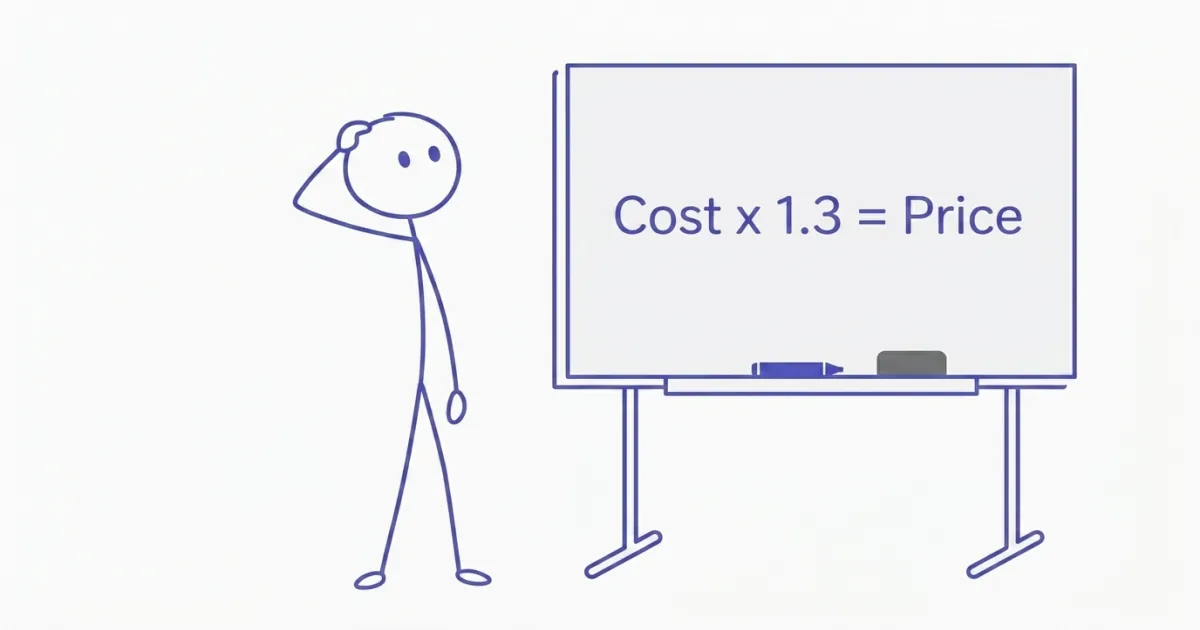
Why do so many small shops end up losing money on products that "should" be profitable? I've asked a bunch of shop owners how they set prices, and the answer is almost always some version of "cost times 1.3." Sounds precise. It isn't. It's a guess wearing a decimal point.
Here's what that guess looks like on paper:
Cost = $10
Markup = 30%
Selling Price = $13
Fine on a whiteboard. Now watch what happens to that $13 after someone actually buys the thing. Stripe or PayPal takes its 3%. Whatever platform you're selling on, whether that's an Etsy fee or a Shopify app or Amazon's cut, takes another chunk, sometimes 15%. Maybe you owe sales tax. You definitely spent something getting that customer to click "buy" in the first place. Add it up and the "30% margin" you were so proud of is now sitting closer to 12%, and you never even noticed the leak because none of that was in your original math.
Stop adding to cost. Start subtracting from price.
The whole problem with cost-plus is which direction you're doing the arithmetic. You start at cost and tack on a hopeful number. The better question runs the other way: after everything gets skimmed off the top, does what's left actually cover the margin I wanted?
Take a ceramic coffee mug. Real cost stack, not the fantasy version:
Product cost       $5.00
Packaging          $0.50
Shipping           $1.50
Marketing (per unit)  $2.00
-----------------------------
Total cost         $9.00

Payment fee        3%
Marketplace fee    10%
Tax                0%
Total cost, $9. Cost-plus at 35% would have you charge $12.15. Except 13% of that $12.15 never reaches you, it goes straight to fees. What's actually left in your pocket is about $1.70. That's a 14% margin, not 35%. You'd have priced this wrong and kept doing it on every mug you sold.
Do it backward instead. Find the price where, after that 13% gets clipped off, what remains still covers your $9 cost plus the 35% you actually want:
price × (1 − 0.13 − 0.35) = $9
price = $9 / 0.52
price = $17.31
Five dollars higher than the cost-plus guess, on a nine-dollar product. And it gets worse the pricier the item, since fees scale with the sale price and cost-plus has no way to account for that.
The three costs everyone forgets to charge for

Payment processing eats a little on every single sale, usually 2.5 to 3.5%. Doesn't sound like much until you remember it's a cut of revenue, not profit, so it bites your margin harder than the percentage suggests.
Marketplace commission is the one people genuinely forget exists. If you're on Etsy, Amazon, or a Shopify app with its own take rate, this is frequently the biggest number in the whole stack. Amazon's own seller fee schedule lists referral fees from 8% up to 15% depending on category, and that's before payment processing on top.
And marketing cost per unit is not your whole ad budget, just the slice that one product needs to sell a single copy of itself. Spend $200 in ads and sell 100 units, that's $2 you have to recover per sale, same as any other input cost.
Do the math cost-plus in your head and none of these three ever enter the picture. Work backward from price and they can't be avoided. That's the whole argument, really. Not that cost-plus is lazy. That it's structurally incapable of seeing three of your biggest costs.
You actually need three prices, not one
Once you're solving it backward, it's worth having three numbers on hand, because they're answering different questions.
Minimum price is breakeven. Zero profit, but you're not bleeding either. Handy to know so a "flash sale" doesn't accidentally put you underwater.
Recommended price is the one with your real margin baked in. This is what goes on the product page.
Premium price sits maybe 15-25% above recommended, meant for a nicer version, a bundle, or just to see if the market will actually pay more. You won't know until you try, but having the number ready beats redoing the math from scratch every time you want to test it.
Do this math once, not every time you list a product
I'll be honest, solving this backward by hand works fine for the first product. By the third one that week you're rushing it, rounding wrong, sliding right back into cost-plus without meaning to. So we built a Product Price Calculator that runs the backward solve for you. Punch in cost, packaging, shipping, marketing, your fees, tax, and target margin, and it spits out minimum, recommended, and premium price with a full breakdown of where every dollar goes. It'll also round to something people expect to see on a price tag, since $17.31 reads like a typo and $17.99 doesn't.
The formula isn't really the point. The habit is: ask what's left after fees, not what you tacked onto cost. Get that question automatic and the slow, invisible margin leak stops.